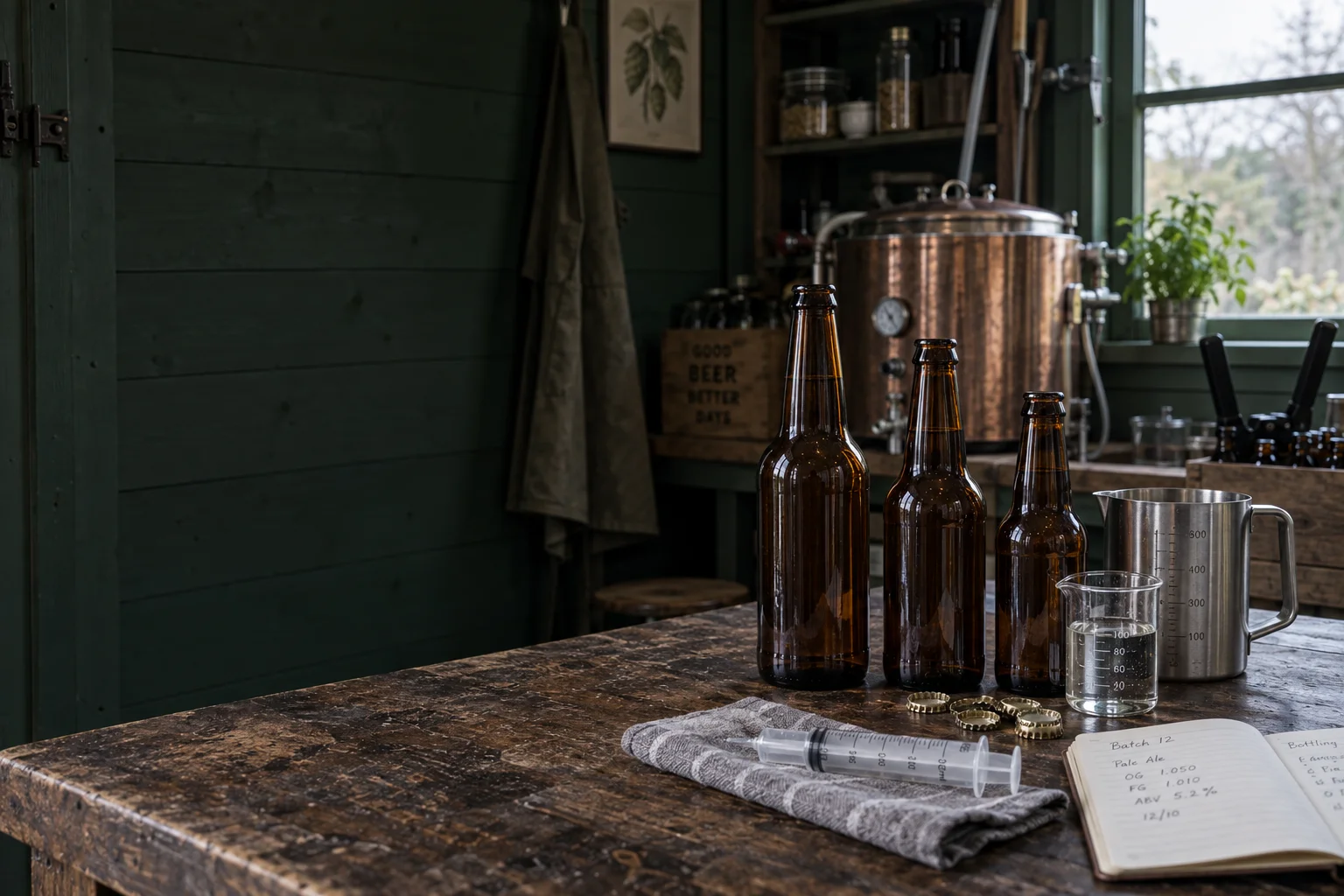
A homebrewing workshop with amber bottles, a kettle, dosing syringe and bottling notebook

BOTTLE & BENCH FIELD TOOL / 01

Per-bottle
priming solution
calculator.

For the bottles on your bench.
Measure one solution. Make every dose count.

Open the worksheet

No account. No installation. Works offline.

THE HOME BREWING WORKSHOP

Small batches.
Mixed bottles.
One measured solution.

THE WORKSHEET

Let’s set up the bench.

1

Set up your beer

BEFORE PRIMING
vol. CO₂
Use your recipe and bottle specifications.
Representative warmest beer temperature during or after fermentation, not serving temperature. Why it matters
Only this portion of the batch, before solution is added. Exclude trub and transfer losses.
Choose your priming sugar
Use plain sugar. For dextrose, check your supplier’s product specification; anhydrous glucose is not interchangeable with this model.
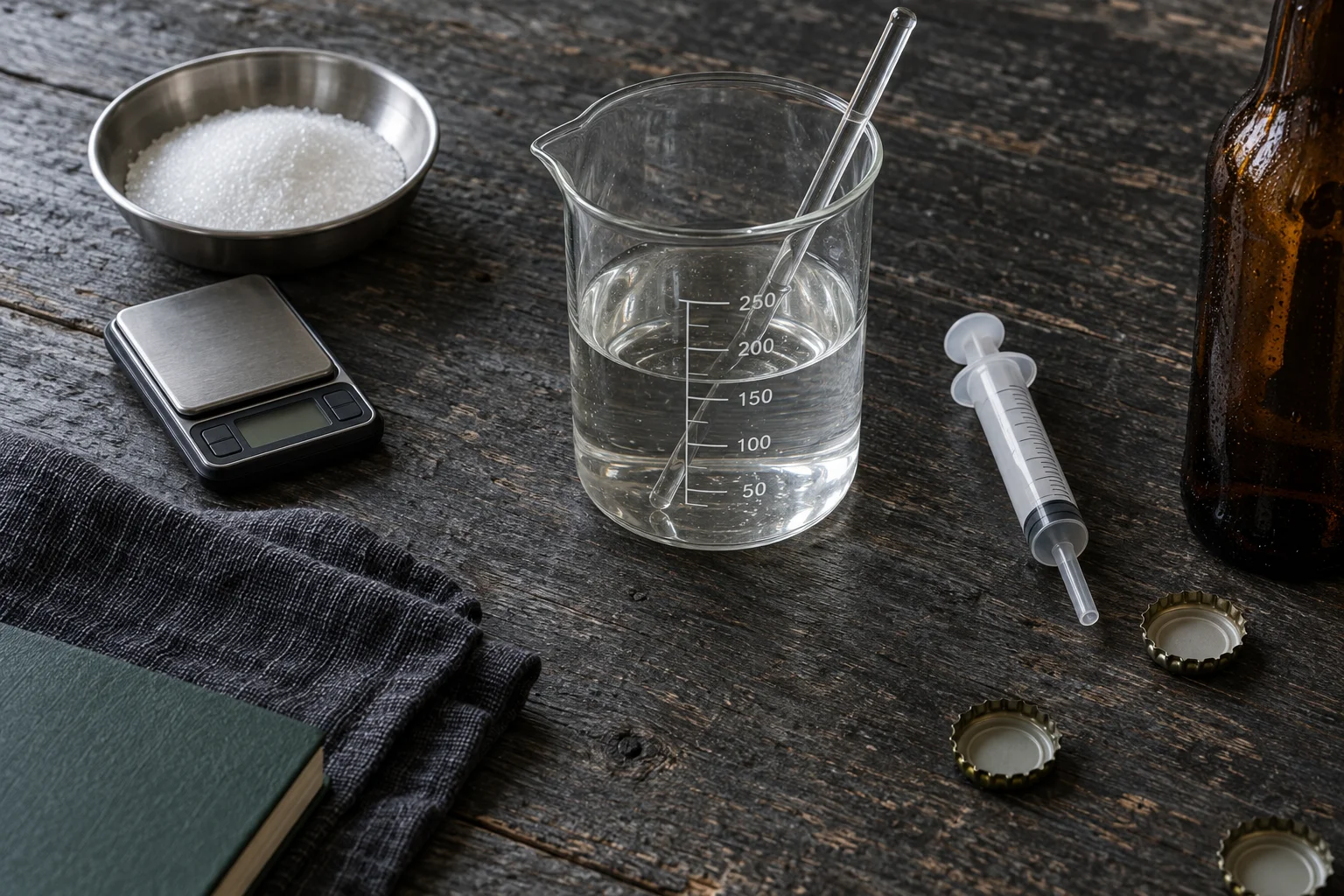
Sugar, a scale, a beaker and a dosing syringe ready for solution preparationWEIGH → DISSOLVE → MEASURE
2

Measure the solution

Dissolve the full calculated sugar weight, cool, then measure the whole solution. This is not the starting water volume.

Planning first? Enter an intended final volume. Replace it with the cooled, measured volume before dosing. If you change the beer, target or sugar after mixing, prepare a matching solution again.

3

Build your bottle lineup

Enter the beer fill in each bottle, excluding sugar solution. Allow appropriate headspace after dosing.

Sugar and a scale on the workbench01

Weigh & dissolve

Use a scale. Prepare the calculated sugar with sanitary equipment and follow your brewing source’s sanitation procedure.

Clear measuring beaker02

Cool & measure

Measure the final solution, fully mixed and dissolved. Update the worksheet with that measured volume.

Mixed-size amber bottles ready for bottling03

Dose & account

Add the listed dose once per bottle. Keep track of treated bottles. Never add a second bulk-priming dose.

THE BREWER’S REFERENCE

Methodology

MODEL NOTE / 15 SEP 2026

What a “volume” means

One volume means one litre of CO₂ gas, at 0 °C and one atmosphere, per litre of beer. Priming adds to CO₂ already retained from fermentation.

Temperature is an estimate of history

We use Brewer’s Friend’s temperature polynomial. Warmer beer generally retains less CO₂, so more sugar is needed for the same target. For vented fermentation, use a representative warmest temperature during or after fermentation. Do not simply enter a cold-crash or serving temperature. The source acknowledges uncertainty after cold storage and temperature changes.

Pressure fermentation, spunding, force carbonation, prolonged cold storage, or an unknown history are outside this worksheet. No temperature-only formula can establish their actual residual CO₂.

One model, consistently applied

Brewer’s Friend’s published calculator code uses 4 g/L for each additional CO₂ volume with sucrose, and divides by 0.91 for corn sugar. We reproduce that practical model, including its sugar assumptions. It is not a product-specific purity assay or a complete chemical simulation.

Different tools can use different sugar-yield, hydration and residual-gas assumptions. We do not average their constants. Lallemand credits the 1995 Zymurgy article but does not publish the equation in its readable calculator text; that attribution alone is not an independent numerical validation.

The AHA extract-brewing tutorial gives a recipe-specific rule of 1 oz dextrose per US gallon, without an explicit target CO₂ value. It cannot validate a particular target here and is not substituted for the selected model.

The solution is measured, not guessed

The entire calculated sugar mass must be in the final measured solution. For sugar mass M (g) and solution volume S (mL), concentration is M / S. Sugar grams cannot be added to water millilitres to infer this volume.

For beer fill b and total beer B, use fraction b / B. Each bottle gets M × b / B grams, or S × b / B mL of solution. Multiply by the bottle count for each group. This is mass-balance arithmetic, not an additional fermentation model.

Your calculation, line by line

Enter a valid worksheet to see the calculation.

All beer volumes in the equations use litres. Temperature in the residual equation uses °F. Dose volume always appears in mL.

Source notebook

  1. Brewer’s Friend: Beer Priming Calculator ↗

    Primary model, public code and public default example. Accessed 15 September 2026.

  2. AHA: All-Extract Homebrewing ↗

    Fermentation checks and sanitation context. No airlock activity does not prove completion.

  3. Lallemand: Bottle Conditioning Calculator ↗

    Additional professional reference. Acknowledges Zymurgy, Summer 1995.

The legacy AHA “Brew By the Numbers” PDF link returned 404 during research. We do not claim to have verified that original article.

Reference check, rounding & model scope

Public reference: Brewer’s Friend’s default worksheet uses 5 US gal, 68 °F and 2.0 CO₂ volumes. It displays residual CO₂ 0.86 volumes, table sugar 3.0 oz and corn sugar 3.3 oz by weight. Our automated checks allow ±0.005 volumes and ±0.05 oz, the source’s displayed rounding. Full-precision expectations and conservation checks are tested separately. This is a cross-check against the chosen source, not independent laboratory validation.

Conversions: 1 US gal = 3.785411784 L; 1 US fl oz = 29.5735295625 mL; 1 oz by weight = 28.349523125 g; °F = °C × 9/5 + 32. US fluid ounces describe volume; weight ounces describe sugar mass. Imperial gallons are not supported.

MVP limits: 0–30 °C; 1–4.5 target volumes; 0.1–200 L of beer; 50–3,000 mL beer fill; whole bottle counts; at most 24 bottle types. These are conservative software scope decisions, not bottle-pressure ratings. We refuse targets at or below estimated residual CO₂. We accept at most 1 mL batch/bottle rounding difference without renormalizing doses.

Preparation limits: solution at most 5% of beer volume, concentration at most 0.60 g/mL, minimum dose 0.10 mL. These are application limits for an approximate model and manual workflow, not universal solubility or instrument guarantees. The model excludes solution dilution, headspace gas, losses, yeast health, infection and unfermented extract. Warnings start above 2% dilution and below 1 mL dosing.

Rounding is for display only. Adding the solution increases packaged liquid volume; allow headspace. The estimates do not compensate for that added volume or gas in the headspace.

READ BEFORE BOTTLING

Safety &
Limitations

Carbonation creates pressure.
Good arithmetic is only one part of the job.

Glass bottles and measuring equipment on the bottling bench

Confirm fermentation independently

Use appropriate gravity measurements and recipe, yeast and professional guidance to confirm completion. A stalled fermentation can look quiet. This worksheet cannot assess readiness. Unfinished fermentation, contamination and additional fermentables can create unexpected pressure.

Check the actual container

Verify bottle and closure pressure ratings at conditioning temperature with the manufacturer. Inspect for damage and use containers intended for bottle conditioning. There is no CO₂ number that is universally safe for every bottle.

Keep the solution uniform

Use clean, sanitized equipment, a reliable scale and a suitably graduated syringe. Sugar must remain fully dissolved after cooling. Account for every dose, avoid contamination and do not compensate for spills by adding extra sugar to the remaining bottles.

Know when to stop

Unknown CO₂ history, unsupported sugar, added fruit, mixed fermentation or uncertain fermentation completion need specialist guidance. Honey, DME, syrup and anhydrous glucose are unsupported. Estimates do not guarantee carbonation, bottle integrity or freedom from injury.

BENCH NOTES

A few good
questions.

The details that make a small batch easier to account for.

Can I bottle just part of my batch?

Yes. Enter only the beer going into those bottles, excluding losses. Prepare the displayed sugar mass for that portion. Do not enter the fermenter’s full batch if you are only packaging a few litres.

Why does changing the sugar change grams, but not mL per bottle?

The solution is assumed to contain the entire newly calculated sugar mass. With the same final solution volume and beer fills, each bottle receives the same fraction of that solution. If you already made a solution, changing the selected sugar does not change what is physically in it; prepare a matching solution again.

Does 100 g of sugar plus 100 mL of water make 200 mL?

No. Mass and volume are different quantities, and dissolving sugar changes the volume non-additively. Measure the whole cooled solution after dissolving; do not calculate it by adding grams to millilitres.

What if my bottle sizes do not add up?

Doses pause when the difference exceeds 1 mL. Adjust the beer fills, bottle counts, or the actual amount being packaged. Never divide the whole solution among fewer bottles to “use it up.”

Is 12 oz the same as 330 mL?

No. A 12 US fl oz beer fill is 354.88235475 mL. Choose US fl oz on that bottle card. The word “oz” in a sugar-weight result means mass, not fluid volume.

Can I save or use the worksheet offline?

All calculation files, fonts and images are local. An opened local copy works offline. Print a worksheet after completing the checks, or choose “Save as PDF” in your browser’s print dialog. Values are not retained after reloading.